Who is Ishtar? The Earth Mother in Conan’s World – Explained

Disclosure: This post is reader-powered and contains affiliate links. If you click through and make a purchase, I may earn a commission at no additional cost to you.
Table of Contents
Where Mitra offers austere dignity and intellectual worship, Ishtar offers passion, fertility, and the warm embrace of the earth itself.
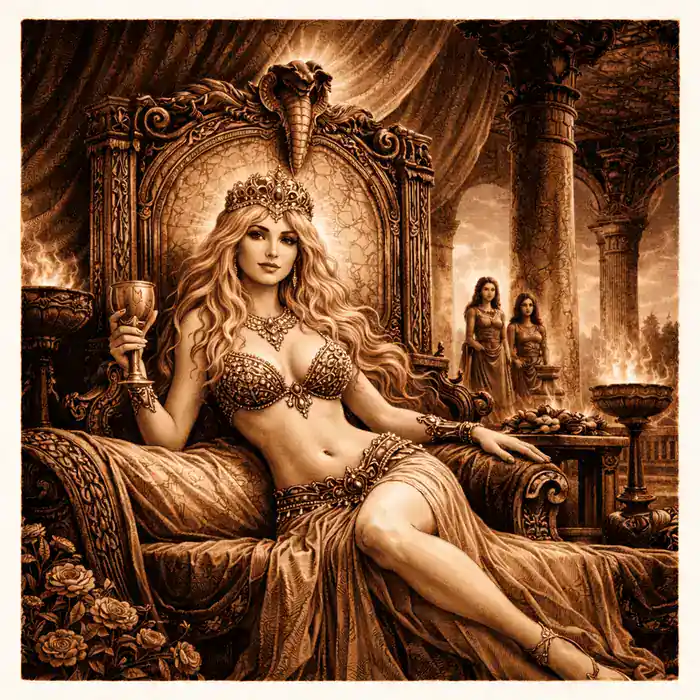
She’s the goddess of the Shemites, worshipped in lavish temples filled with ivory idols and exotic ceremony. Her rites include blood sacrifice and, famously, temple prostitution. To Hyborian sensibilities, she represents everything dangerously seductive about the East.
What I find interesting about Ishtar is how Howard uses her to explore the tension between “civilised” and “sensual” religion.
The Hyborian kingdoms look down on Ishtar worship as primitive and scandalous, yet several of them – Koth, Khoraja, Khauran – abandoned Mitra for her more passionate rites. There’s something the cold temples of Mitra can’t provide that Ishtar’s rich shrines can.
Howard’s Original Vision
Ishtar appears throughout the Conan stories as the primary goddess of Shem and the eastern kingdoms. Howard based her directly on the Mesopotamian goddess Ishtar (also known as Inanna) – the ancient deity of fertility, sexuality, and war.
Unlike many of Howard’s divine names, which he merely borrowed while creating something original, his Ishtar functions much like her historical counterpart.
She’s an earth mother, a fertility goddess, and her worship involves the sacred sexuality that characterised actual Mesopotamian temple practice.
Howard describes Ishtar’s worship in “The Official Handbook of the Conan Universe” material: “Ishtar, the ancient Mother Goddess, is worshipped in rich temples and at lavish shrines with rituals of blood sacrifice and orgiastic frenzy performed before sensuously carved idols of ivory.” It’s a striking contrast to Mitra’s bare altars and dignified simplicity.
The Earth Mother of Shem
The Shemites are Howard’s version of the ancient Semitic peoples – Babylonians, Assyrians, and their neighbours. Their worship centres on Ishtar, who eclipses all other deities in their pastoral land.
If there are male gods in the Shemite pantheon, Howard suggests, their names remain unknown to history. Goddess worship completely dominates.
This fits historical patterns. The mother goddess was often the supreme deity in agricultural societies, where fertility of land and livestock meant survival. Ishtar’s role as earth mother – guaranteeing bountiful harvests and many children – made her essential to Shemite life.
Her temples were famous throughout the Hyborian world for their luxury. Where Mitra’s shrines valued austere simplicity, Ishtar’s houses of worship were “rich, lavish and exotic,” filled with colourful decorations, ornate ceremony, and sensuously carved ivory statues.
To Westerners from the Hyborian kingdoms, these temples must have seemed dangerously appealing.
Indeed, Conan: Spawn of the Serpent God begins with just such a heist.
Temple Prostitution and Sacred Sexuality
The most notorious aspect of Ishtar worship is her temple prostitutes – sacred women who served the goddess through ritual sexuality.
These were not merely courtesans who happened to work in temples; their role was explicitly religious, offering worshippers communion with the divine through physical pleasure.
Howard presents this without significant moral judgment. He notes that “the voluptuous temple prostitutes which were found in Ishtar’s temples were well known even outside the lands where the goddess was worshipped.” They’re famous, perhaps scandalous to some, but not condemned as evil.
This reflects actual historical practice. Sacred prostitution was a genuine feature of ancient Near Eastern religion, though scholars debate its exact nature and extent.
Howard incorporated it into his worldbuilding as one of the ways Ishtar worship differed from Mitra’s more ascetic faith.
Ishtar’s Idols and Worship
The Shemites believed their gods actually inhabited their idols – a significant theological difference from Mitra worship, where statues merely represented the god.
When you prayed before an Ishtar idol, you were praying to the goddess herself, who was genuinely present in that ivory form.
Howard describes these idols as “caricatures” with “swollen breasts and belly” that appeared “repulsive to the more refined worshippers of Mitra.”
This is the Hyborian perspective – the Shemites themselves presumably found these figures beautiful representations of fertility and abundance. It’s a neat bit of cultural relativism in Howard’s worldbuilding.
Blood sacrifice was part of Ishtar’s rites, but only of animals, not humans. This places her worship between Mitra (no sacrifice at all) and Set (human sacrifice demanded). The blood offerings were meant to bring Ishtar’s favour in harvests and fertility.
Ishtar’s Spread Beyond Shem
While primarily a Shemite goddess, Ishtar’s worship spread throughout the Hyborian world. She was worshipped in Shem (obviously), but also in Ophir, Argos, Koth, Khoraja, Khauran, and Zamora. Small cults existed wherever Shemite populations had settled.
It’s worth noting that Howard lists Ishtar alongside other Shemite goddesses – Ashtoreth and Derketo – as separate deities. In “Queen of the Black Coast,” Bêlit names “the gods of the Shemites – Ishtar and Ashtoreth and Derketo and Adonis.”
While later adaptations (particularly Marvel Comics) sometimes conflated these goddesses as aspects of a single deity, Howard’s original text treats them as distinct figures in the Shemite pantheon.
Several Hyborian kingdoms that once worshipped Mitra switched to Ishtar’s more sensual rites. Koth abandoned the god of light for the earth mother, as did Khoraja and Khauran.
This suggests that Mitra’s distant, intellectual worship couldn’t satisfy all spiritual needs – some people wanted a goddess they could feel, whose worship engaged the body as well as the mind.
Ishtar and Mitra: Competing Faiths
The contrast between Ishtar and Mitra represents a fundamental tension in Hyborian religion. Mitra offers truth, restraint, and civilised dignity. Ishtar offers passion, fertility, and earthy sensuality.
Both are generally benevolent deities – neither demands human sacrifice or promotes evil – but they represent fundamentally different approaches to the divine.
From the Mitraic perspective, Ishtar worship is primitive and scandalous. Her temples are too rich, her rites too physical, her idols too explicit. Proper religion should be dignified and intellectual, not this orgiastic indulgence.
From the Ishtar perspective (though Howard rarely writes from it), Mitra worship is probably cold and sterile. What good is a god you can’t touch, whose temples are bare, whose priests offer nothing but sermons? Ishtar gives her worshippers something tangible – pleasure, fertility, abundance.
I think Howard’s sympathies lie somewhere between these poles. He clearly admires Mitra’s association with civilisation and truth, but he also presents Ishtar worship without the condemnation we might expect from a 1930s American author.
Ishtar in the Stories
Ishtar appears directly in the comics rather than Howard’s original stories, though she’s mentioned throughout the Conan tales. In one comic adaptation, Conan encounters Ishtar herself, using the alias “Alonia,” in the ruined city of Ababenzzar. She’s pursuing a priest who stole her “lifestone,” a source of divine power.
The story shows Ishtar as genuinely divine – capable of magic, functionally immortal, but also somewhat petty (she cursed a woman named Isolene for being too beautiful, then apparently forgot about her).
It humanises the goddess in ways that fit the Hyborian worldview, where gods are powerful beings rather than perfect moral exemplars.
Why Ishtar Matters
Ishtar serves multiple functions in Howard’s worldbuilding. She represents the sensual, earthy religions of the East that the Hyborian kingdoms find both fascinating and threatening.
She provides an alternative to Mitra that isn’t simply evil (like Set), showing that the religious landscape is more complex than good god versus bad god.
She also represents the feminine divine in a way that Mitra (explicitly male) doesn’t provide. The Shemites worship a goddess, not a god, and her domain – fertility, sexuality, the earth – encompasses aspects of life that Mitra’s stern masculinity ignores.
I think Ishtar is underexplored in Howard’s original fiction – she appears mostly as background colour rather than an active force. But her presence enriches the world, suggesting depths of religious practice and belief that the stories only hint at.
Related Reading
- Gods of the Hyborian Age – Complete Guide
- Who is Mitra? The God of Light Explained
- Who is Set? The Serpent God Explained
- Where is Stygia? The Land of Set
- Who is Crom? Conan’s God Explained
- Bel, God of Thieves
- Ymir, God of the North
Frequently Asked Questions
Is Ishtar based on a real goddess?
Yes – Howard based his Ishtar directly on the Mesopotamian goddess Ishtar (also called Inanna), the ancient deity of fertility, sexuality, and war. Unlike many of his divine names, which he adapted significantly, Howard’s Ishtar functions similarly to her historical counterpart, including the presence of temple prostitution.
Is Ishtar in Conan Exiles?
No, Ishtar is not among the selectable religions in Conan Exiles. The game does include Derketo, a goddess of passion and fertility who shares some characteristics with Ishtar (and may be the same goddess under a different name). If you want an Ishtar-like experience in Conan Exiles, Derketo is your closest option.
What’s the difference between Ishtar and Derketo?
In Howard’s original stories, they are separate goddesses – he lists them alongside each other as distinct Shemite deities in “Queen of the Black Coast.” Derketo is associated more with Stygia and the Black Kingdoms, appearing in “Xuthal of the Dusk” (also known as “The Slithering Shadow”). Later adaptations, particularly Marvel Comics, sometimes conflated various Shemite goddesses as aspects of a single deity, which has caused some confusion. In Conan Exiles, Derketo (not Ishtar) is the playable goddess of passion and fertility.
Is Ishtar evil?
No – Ishtar is generally benevolent, a fertility goddess who blesses harvests and fertility. Her worship includes animal sacrifice (but not human sacrifice) and sacred prostitution, which Hyborian moralists find scandalous but which isn’t presented as evil. She’s simply different from Mitra, not opposed to him in the way Set is.
Why did kingdoms abandon Mitra for Ishtar?
Howard suggests that Mitra’s austere, intellectual worship couldn’t satisfy all spiritual needs. Ishtar’s sensual, physical worship offered something different – connection to the divine through the body rather than just the mind. Kingdoms like Koth, Khoraja, and Khauran apparently found this more appealing than Mitra’s distant dignity.
What is sacred prostitution?
In Ishtar’s temples, certain women served the goddess through ritual sexuality with worshippers. This was explicitly religious rather than merely commercial – the act was meant to bring communion with the divine. This practice reflected actual ancient Near Eastern religion, which Howard incorporated into his worldbuilding.