Conan the Mercenary Era Guide: Best Comics & Essential Stories

Disclosure: This post is reader-powered and contains affiliate links. If you click through and make a purchase, I may earn a commission at no additional cost to you.

After the shadow-work of Zamora comes something harsher: war in daylight.
In the Mercenary Era, Conan leaves tower climbing and alley survival behind and steps onto battlefields where armies clash, cities burn, and kings wager thousands of lives for a throne or a diamond crown.
It is here – in muddy trenches, desert sieges, and doomed fortresses – that the young Cimmerian learns the brutal mathematics of the Hyborian Age: strength alone does not win wars, and loyalty is a currency more fragile than gold.
This era finds Conan between the ages of about 20 to 23. I think it’s a great era as Conan (mostly) leaves the thieving behind but it’s before the more emotionally challenging Corsair times with Bêlit.
Note: Robert E. Howard never wrote an exact “Mercenary Era.”
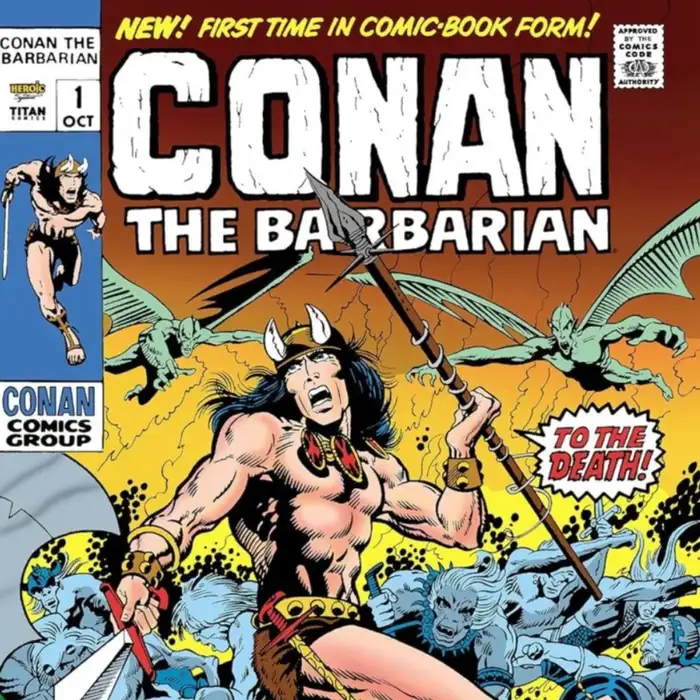
Most of what we call this era comes from Marvel comics, particularly Conan the Barbarian #17–31, later additions in Savage Sword, and modern reinterpretations.
The one thing we do have from the main man himself (Robert E Howard) is The Hand of Nergal – but it was an unfinished fragment, later completed by Lin Carter.
There are several non-Conan Robert E Howard stories that were adapted by Roy Thomas and fit in perfectly to the era (The Blood of Bel-Hissar) is a great example.
Table of Contents
Mercenary Era in 30 Seconds (Quick Summary)
If you’re new to this era, start here:
- Conan the Barbarian #17–18 – The Gods of Bal-Sagoth (here we meet the legendary Fafnir)
- #19–21 – The Makkalet war begins
- #23–24 – Red Sonja enters the legend
- #25–26 – Fall of Makkalet and a turning point for Conan
- #27–29 – Desert wanderings and service in Turan
- #30–31 – The Hand of Nergal (one of the best standalone arcs)
Optional extras:
Savage Sword of Conan #1 – Curse of the Undead-Man
Conan the Barbarian #228–229 – Red Teeth (flashback)
This gives you a perfect entry path into the mercenary era.

What Is “Conan the Mercenary”?
The Mercenary Era covers the years Conan spends fighting for coin across Turan, Hyrkania, and the border kingdoms.
He serves under princes, generals, rebel tribes, and occasionally alongside Red Sonja. He learns the tactics of cavalry, siege warfare, desert marching, and the ugly politics behind every throne room.
This era is defined by:
- vast battles rather than rooftop duels
- shifting alliances that never last
- Conan building the discipline and leadership that will eventually make him a general, warlord, and king
- early lessons in the cost of loyalty
If the Thief Era is smoky torchlight and whispered deals, the Mercenary Era is the clash of shields and the thunder of massed cavalry.
That being said, there are definitely still adventures where Conan is sneaking into tombs and temples (and he will always continue to do).
Conan’s Transformation in the Mercenary Era
Here, Conan evolves from lone wanderer to soldier capable of commanding men. He becomes:
More strategic
He studies supply lines, scouts, chokepoints, and troop morale – survival depends on more than raw strength.
More worldly
He works alongside Turanians, Hyrkanians, desert tribes, and borderland city-states, learning their customs, armour, and gods.
More dangerous
He becomes a battlefield tactician, mastering the spear wall, cavalry charge, and ambush.
More disillusioned
Conan discovers that kings and generals rarely fight for noble causes; most wars are about wealth, pride, or magic best left buried.
These lessons shape his later roles as general, warlord, and finally king.
Mercenary-Era Reading Order (Light Guide)
This is not a strict continuity chart – just a tight reading flow that captures the best of the era. Dark Horse have also done some sterling work on this period, and it can be found in the early Epic Collections or Dark Horse omnibus.
- Conan the Barbarian #17–18 – The Gods of Bal-Sagoth
- Conan the Barbarian #19–21 – Hawks from the Sea – Black Hound – Monoliths
- Conan the Barbarian #23–24 – The Shadow of the Vulture – The Song of Red Sonja
- Conan the Barbarian #25–26 – Mirrors of Kharam-Akkad – Hour of the Griffin
- Conan the Barbarian #27–29 – Blood of Bel-Hissar – Moon of Zembabwei – Two Against Turan
- Conan the Barbarian #30–31 – The Hand of Nergal – The Shadow in the Tomb
Optional / Expanded:
- Savage Sword of Conan #1 – Curse of the Undead-Man
- Conan the Barbarian #228–229 – Red Teeth (flashback to Turanian service)
I would highly recommend getting hold of the Conan Original Comics Omnibus One and then moving onto the second Conan omnibus if you haven’t already.

Essential Comics of the Mercenary Era (Curated Guide)
This section highlights some of the strongest, clearest stories depicting Conan as a mercenary.
Conan the Barbarian #17–18 – “The Gods of Bal-Sagoth”
A violent introduction to the era: crashed ships, warring island factions, forgotten gods, and first hints of Conan’s battlefield cunning.
Themes: destiny vs manipulation, early leadership, mythic warfare.
Conan the Barbarian #19–21 – The Makkalet War Begins
These issues plunge Conan into a multi-faction war around Makkalet, featuring Turanian princes, shifting alliances, and brutally costly battles.
This is where the series begins treating Conan not as an isolated adventurer, but as one soldier in a much larger geopolitical struggle.
Conan the Barbarian #23 – “The Shadow of the Vulture”
Conan crosses paths with Red Sonja for the first time during a siege filled with political betrayal, long-range assassins, and clashing armies.
This is one of the most iconic mercenary-era stories and essential for understanding their dynamic.
Conan the Barbarian #24 – “The Song of Red Sonja”
A legendary one-shot where Sonja steals every scene – swaggering, sharp-tongued, and impossible to ignore.
Conan learns that allies can be as dangerous as enemies.
Conan the Barbarian #25–26 – “Mirrors of Kharam-Akkad” & “Hour of the Griffin”
Court intrigue collides with battlefield chaos, and Conan discovers just how fragile Turanian politics are.
These issues close the Makkalet sequence with high sorcery and tragic consequences.
Conan the Barbarian #27–29 – “Blood of Bel-Hissar,” “Moon of Zembabwei,” “Two Against Turan”
A transition arc where Conan begins drifting out of the war and toward new lands. The Blood of Bel-Hissar has some of my favourite Conan art of all time.
- #27: desert mutinies and cursed relics
- #28: jungle sorcery
- #29: Conan joins the Turanian army formally
Conan the Barbarian #30–31 – “The Hand of Nergal” & “The Shadow in the Tomb”
A classic supernatural arc. The Hand of Nergal is one of the most memorable magical artifacts in Conan lore – a talisman that preys on fear itself.
These issues show Conan fighting not just soldiers but a force of cosmic dread.
Bonus: Curse of the Undead-Man (Savage Sword of Conan #1)
Though not strictly war-bound, this is a superb early-career mercenary tale: necromancy, betrayal, and a nightmarish chase through a doomed city. It again includes Red Sonja and I see it as a kind of crossover between Thief and Mercenary.

Major Themes of the Mercenary Era
The hollowness of noble causes
Many wars Conan fights have no heroic purpose. Makkalet is the prime example: a conflict fuelled by false relics, pride, and political self-deception.
The fragility of alliance
Turanian nobles betray each other; mercenaries switch sides; Red Sonja remains loyal only to herself.
The growth of a leader
Conan begins observing which commanders inspire loyalty and which drive men to pointless death. These lessons build the future general.
Magic on the battlefield
Artifacts like the Hand of Nergal show that war in the Hyborian Age is never purely mundane.
Where the Mercenary Era Fits in Conan’s Life
This era sits after his early Zamorian adventures but before his days as pirate, corsair, free companion, warlord, and king.
It is here he learns:
- how armies actually function
- why political power corrupts
- how to lead men through fear, courage, and example
- why he will later distrust priests, kings, and “noble causes”
Without the Mercenary Era, King Conan would probably not exist.
Collecting Conan the Mercenary (Simple Guide)
For readers and collectors who want a clean bookshelf path:
- Marvel Omnibus: Conan the Barbarian Vol. 1 – includes #17–31, the core mercenary run
- Epic Collection: The Coming of Conan / Queen of the Black Coast – overlap with early-war material
- Titan’s Savage Sword Omnibus line – excellent for expanded material and beautifully restored art. Also includes Curse of the Undead-Man and other early mercenary-flavoured tales.

See Also
- Conan the Thief era guide – precursor to the mercenary mindset, and where he learnt many relevant skills.
- Conan the Wanderer era guide – Conan covers large swathes of the Hyborian Age and expands his knowledge rapidly.
FAQ
What is the Mercenary Era in Conan’s life?
The mercenary era is when Conan joins various armies and warbands across Turan, Hyrkania, and the Vilayet, shifting from small-scale thievery and wandering to organised warfare. It represents his first experience with military hierarchy, battlefield strategy, and the politics of powerful nations.
What stories or comics define Conan the Mercenary?
Key stories include The Gods of Bal-Sagoth, The Black Hound of Vengeance, The Shadow of the Vulture, The Blood of Bel-Hissar, and The Hand of Nergal. These arcs show Conan fighting for Turan, surviving betrayals, and facing supernatural threats tied to warfare and empire.
Where does the Mercenary Era fit in the overall Conan timeline?
The mercenary period comes after the thief era in Zamora and before Conan becomes a long-distance wanderer. It is typically placed in his late teens to early twenties, marking the transition from lone rogue to seasoned fighter.
Does Robert E. Howard describe Conan’s mercenary years in detail?
Howard references Conan’s mercenary service in Turan but does not provide a long, continuous narrative for this era. Most detailed depictions come from Marvel, Dark Horse, and later adaptations expanding on Howard’s brief notes.
Why is the Mercenary Era important to Conan’s development?
It teaches Conan discipline, logistics, and battlefield command – skills that later make him an effective general, warlord, and eventually king. Many of his attitudes toward rulers, priests, and armies originate in this era.