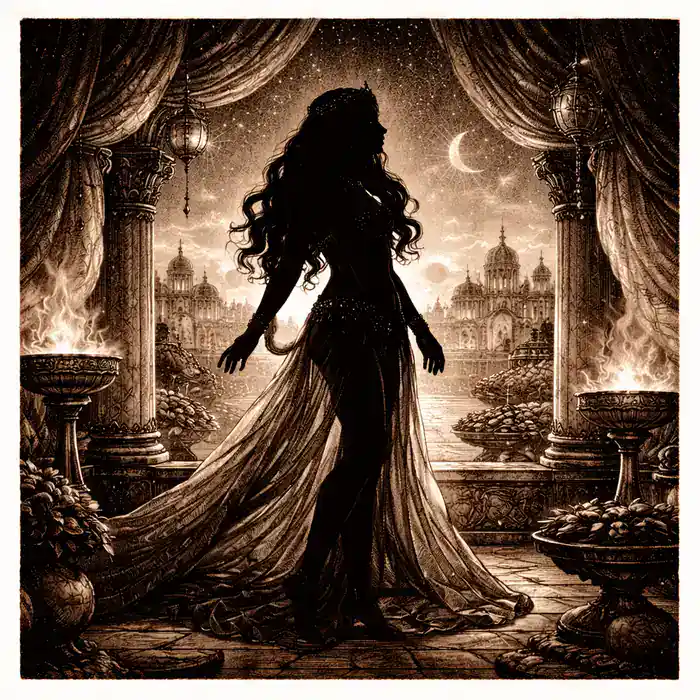
Who is Bel? The God of Thieves in Conan’s World – Explained

Disclosure: This post is reader-powered and contains affiliate links. If you click through and make a purchase, I may earn a commission at no additional cost to you.
Table of Contents
“By Bel, god of all thieves!” It’s an oath you’ll hear in every tavern in Zamora, every thieves’ den from Arenjun to Shadizar.
While Cimmerians invoke Crom and priests pray to Mitra, those who earn their living with quick fingers and quicker feet have their own patron: Bel, the masked god who blesses all who steal with skill.
What I love about Bel is how he represents the practical, transactional nature of Hyborian religion at its most honest.
There’s no pretence of morality here, no claims of cosmic righteousness. Bel’s philosophy is simple: if you’re skilled enough to take something, you deserve to have it.
If you don’t want your belongings taken, be craftier than those who want them. It’s a refreshingly amoral faith for a refreshingly amoral profession.
Howard’s Original Vision
Bel appears in one of Howard’s most famous stories, “The Tower of the Elephant,” where a character swears by “Bel, god of all thieves” while bragging about a kidnapping scheme in the Maul, Arenjun’s notorious thieves’ quarter.
The oath establishes Bel immediately as the patron of criminals throughout the Hyborian world. Howard drew the name from Baal/Bel, the ancient Semitic title meaning “Lord” that was applied to various Mesopotamian deities.
By making Bel a god of thieves rather than a storm god or fertility deity, Howard created something original while maintaining the flavour of ancient religion.
Bel is primarily a Shemite deity – the god originated in Shem, where his main temple (a ziggurat in the city of Shumir) still stands. But his worship spread far beyond Shemite lands because, well, there are thieves everywhere.
Wherever cities exist, wherever merchants accumulate wealth, there are people willing to pray to Bel before relieving them of it.
The Philosophy of Bel
Bel’s faith teaches a straightforward philosophy: take what you can, keep what you take. There’s no altruism in this religion.
Charity is for fools, and beggars who worship Bel don’t consider themselves charity cases – they’re simply using different skills to acquire resources.
The religion teaches that others will prey upon you if permitted, so you should become the predator. This isn’t presented as evil, merely practical.
The world is full of people who want things; some acquire them through honest labour, others through clever theft. Bel blesses those who choose the latter path and do it well.
I find this approach philosophically interesting because it rejects the moralistic framework of most fantasy religions.
There’s no good-versus-evil struggle, no cosmic stakes. Just the acknowledgment that some people steal, some get stolen from, and the clever ones come out ahead.
Worship and Temples
Bel’s temples are deliberately hard to find. In cities with a single dominant thieves’ guild, the temple connects to the guild hall via underground tunnels.
In cities like Arenjun where multiple guilds compete, the temple occupies a neutral underground location where all factions can meet safely.
None has ever seen Bel’s face – appropriate for a god of thieves. His idols depict him variously: a stocky dwarf with a grinning face, a six-armed elephant-man, or a lithe panther-like figure wearing a black mask.
The inconsistent depictions might represent regional variations, or might simply reflect the fact that nobody actually knows what Bel looks like.
The priesthood is organised independently in each major city to prevent problems in one location from affecting others.
If the authorities crack down on Bel worship in Shadizar, the temples in Arenjun continue operating unaffected. It’s a sensible structure for an illegal faith.
Priests of Bel operate under an interesting restriction: they may never buy or trade for anything. If they slip and purchase something legitimately, Bel can only be appeased by sacrificing stolen goods worth ten times the value of what they bought.
This keeps the priesthood true to their god’s principles – everything they have, they must have taken.
Arenjun: The City of Thieves
Bel is the patron deity of Arenjun, the infamous City of Thieves in Zamora. While Zath, the spider god, dominates Zamora’s official religion, Bel commands the loyalty of Arenjun’s true power structure – the thieves’ guilds that actually run the city.
As a slight aside, there is an excellent feeling of Set vs Zath vs other gods in Tim Waggoners new Conan novel, Conan: Spawn of the Serpent. Definitely worth a read.
“The Tower of the Elephant” gives us our best look at Arenjun’s underworld. It’s still one of my favourite Conan stories ’til today, and I always recommend it when starting Conan.
It’s also been adapted a couple of times by Marvel, and the new colourised version of the Savage Sword of Conan Reforged is a real beauty to look at.
The Maul district is where “the thieves of the east hold carnival by night,” where “honest people shun the quarters, and watchmen, well paid with stained coins, do not interfere with their sport.” It’s a place where “steel glints in the shadows where wolf preys on wolf.”
In this environment, Bel isn’t just worshipped – he’s essential. Thieves need somewhere to meet on neutral ground, someone to swear oaths before, a framework for the complex relationships between competing guilds. Bel provides all of this, his faith serving as the operating system for organised crime throughout the Hyborian world.
Bel in the Comics
Marvel’s Conan comics expanded Bel’s mythology significantly. One story established that Bel was once a six-armed deity who commanded armies of dead thieves in the ancient past.
The goddess Ashtoreth defeated him and severed his sixth arm, destroying his power and exiling him to what became Zamora.
This origin explains some of the idols showing Bel as six-armed – they preserve a memory of his original form. It also connects Bel to the ancient divine wars that shaped the Hyborian world, making him a fallen god rather than merely a local deity.
The comics also showed characters taking vows of silence to Bel, cutting their own tongues as sacrifice. This extreme devotion makes sense for a god of thieves – a follower who literally cannot speak can never betray his companions under torture.
Bel and Conan
Conan himself has an interesting relationship with Bel. During his years as a thief in Zamora – the period depicted in “The Tower of the Elephant” – he would have been familiar with Bel worship even if he didn’t actively participate.
A young Cimmerian making his way as a thief in the City of Thieves couldn’t avoid contact with Bel’s followers.
However, Conan worships Crom, not Bel. He might swear by Bel when among thieves (when in Zamora, do as the Zamorians do), but his primary invocations are always to his Cimmerian god. This reflects Conan’s identity – even when living as a thief, he remains a Cimmerian barbarian at heart.
Taurus of Nemedia, the legendary “prince of thieves” who appears in “The Tower of the Elephant,” would certainly have been a Bel worshipper.
His incredible skill at theft – the story shows him scaling the Tower using equipment worthy of a god-level burglar – represents exactly what Bel values: taking the impossible through superior craft.
Why Bel Matters
Bel serves an important worldbuilding function in Howard’s fiction. He establishes that religion in the Hyborian Age isn’t limited to cosmic good-versus-evil struggles.
There are practical faiths for practical people, gods who care about specific professions rather than universal salvation.
This makes the world feel more alive and realistic. Real-world ancient religions often had patron deities for specific trades – smiths, sailors, merchants, soldiers. Bel represents the logical extension of this to criminal enterprise. If there are gods for honest professions, why not a god for dishonest ones?
I also think Bel represents Howard’s pragmatic streak. The author clearly enjoyed his thief characters – Conan himself spent years in the profession – and presenting theft as having its own legitimate religious tradition removes some of the moral judgment. Bel’s followers aren’t evil; they’re just people who’ve chosen a particular path, one with its own code, structure, and divine sanction.
Related Reading
- Gods of the Hyborian Age – Complete Guide
- Where is Zamora? The Land of Thieves
- Who is Crom? Conan’s God Explained
Frequently Asked Questions
Is Bel based on a real god?
Howard drew the name from Baal/Bel, the ancient Semitic title meaning “Lord” applied to various Mesopotamian deities. However, the historical Baal was primarily a storm and fertility god, not a god of thieves. Howard used the name while creating an entirely original divine concept.
Is Bel in Conan Exiles?
No, Bel is not among the selectable religions in Conan Exiles. The game features Mitra, Set, Ymir, Yog, Derketo, Zath, Crom, and Jhebbal Sag, but not Bel. Given Bel’s association with the civilised profession of theft, his absence from the Exiled Lands (a wilderness survival setting) makes some sense.
What is the Tower of the Elephant?
“The Tower of the Elephant” is one of Howard’s most famous Conan stories, set in Arenjun, Zamora. It features Bel worship prominently and tells the story of a young Conan attempting to rob a sorcerer’s tower. The story introduces several key elements of Hyborian lore and remains a fan favourite.
Do thieves have to worship Bel?
No – worshipping Bel is optional, and many thieves presumably follow other gods or none at all. However, Bel’s faith provides practical benefits: access to thieves’ guilds, neutral ground for negotiations, and a code of conduct that helps criminals cooperate. Smart thieves in the Hyborian world would at least pay respects to Bel, even if they primarily worship another deity.
Is Bel evil?
Bel isn’t presented as evil in the cosmic sense – he doesn’t demand human sacrifice or seek to destroy civilisation. His philosophy is amoral rather than immoral: take what you can, skill justifies acquisition. Whether theft is “evil” is a moral question Howard largely sidesteps; Bel simply represents a different way of moving through the world.
Where is Bel worshipped?
Bel originated in Shem, where his main temple stands in the city of Shumir. However, his worship has spread wherever cities and thieves exist. He’s particularly prominent in Zamora (especially Arenjun, the City of Thieves), Brythunia, Argos, and Corinthia. Essentially, any place with a significant criminal underworld probably has a shrine to Bel somewhere.