Cimmeria: Conan’s Homeland of Gloom and Steel

Disclosure: This post is reader-powered and contains affiliate links. If you click through and make a purchase, I may earn a commission at no additional cost to you.
Before Conan was a thief, a mercenary, or a king, he was a Cimmerian – born in a land so harsh and grey that even its own people dreamed of escaping it, even as it forged them into the hardest warriors the Hyborian Age would ever know.
The Land Beneath Grey Skies
Howard described Cimmeria with a poet’s precision and a Texan’s longing for wild places.
This is a land of constant clouds, of mountains that scrape a perpetually overcast sky, of dark forests and icy streams. Sunlight is rare. Warmth is rarer. I think Howard poured genuine emotion into his depiction of Cimmeria – it feels like a place he could see clearly in his imagination.
Geographically, Cimmeria sits north of Aquilonia and the other Hyborian kingdoms, bounded by Nordheim to the north and various hostile territories on all sides.
It’s a land of mountains and valleys, of forests and moorlands, of terrain that makes travel difficult and farming nearly impossible.
In my opinion, the geography explains much about the Cimmerian character – these people became hard because softness meant death.
The climate is relentlessly grim. Cold rain, bitter winds, and brief summers that never quite warm the land. Howard’s Cimmeria isn’t the romantic Celtic twilight of some fantasy – it’s genuinely harsh, a place where survival is the first and constant challenge.
The Famous Poem
Howard wrote an actual poem titled “Cimmeria,” and I would argue it’s essential reading for understanding both the land and its creator. The poem captures the desolate beauty Howard imagined:
The grey skies, the dark hills, the sense of a land that has forgotten joy – these images permeate everything Howard wrote about Conan’s homeland. In my view, the poem reveals that Howard saw Cimmeria as both a physical place and a state of mind.
The melancholy in the poem connects to themes throughout Howard’s work. There’s a profound sense of loss, of grandeur fallen into decay, of beauty wrapped in sorrow.
I think this emotional register is what elevates Howard’s pulp adventures into something more lasting – beneath the sword fights and monsters lies genuine feeling.
Cultural Traits
The Cimmerians are Celtic-inspired, drawing on Howard’s reading of Irish and Scottish history and mythology.
They’re organised into clans rather than kingdoms, with no central authority and fierce independence. I would say they’re what Howard imagined the Gaels might have been before civilisation softened them.
Cimmerian values are straightforward: strength, courage, and survival. They respect prowess in battle above all else.
Their religion is grim – they worship Crom, a god who gives men nothing but the strength to survive and expects nothing but that they use it.
No prayers, no mercy, no afterlife worth anticipating. In my opinion, Crom is one of Howard’s most interesting theological creations – a god who embodies harsh self-reliance.
The Cimmerians don’t build cities or write books. They don’t trade much with outside nations. They simply endure, generation after generation, in their grey hills.
This might sound limiting, but I think Howard found something admirable in this simplicity – a purity of purpose that civilisation corrupts.
Forging Conan
Everything about Conan makes more sense when you understand Cimmeria. His physical toughness comes from surviving a land that kills the weak.
His suspicious attitude toward civilisation comes from growing up in a culture that needed none of it. His practical atheism – he believes in Crom but expects nothing from him – reflects the Cimmerian theological outlook.
I would say Conan definitely carries Cimmeria with him throughout his adventures.
When he finds himself in the pleasure palaces of civilised kingdoms, part of him always remains that Cimmerian hill-boy who learned to fight before he learned to speak properly. This tension between barbarism and civilisation drives much of Howard’s best writing.
Howard explicitly stated that Conan left Cimmeria as a youth because even for a Cimmerian, the land was too confining. The wider world called to him.
In some stories this was spurred on by hearing tales of his grandfather’s travels. Yet he never stops being Cimmerian in his essential nature. I think this makes Conan a perpetual outsider in a way that gives the stories their energy – he’s never quite at home anywhere – even on a throne!
Cimmeria in the Stories
Unlike many Hyborian locations, Cimmeria appears rarely in the actual Conan stories. Howard set most adventures in more exotic locales, using Cimmeria primarily as Conan’s origin point and occasional reference.
In my opinion, this restraint was wise – keeping Cimmeria somewhat mysterious preserves its power.
When Cimmerians do appear, they’re formidable. Conan encounters fellow Cimmerians occasionally, and they’re invariably depicted as his equals in toughness and fighting ability.
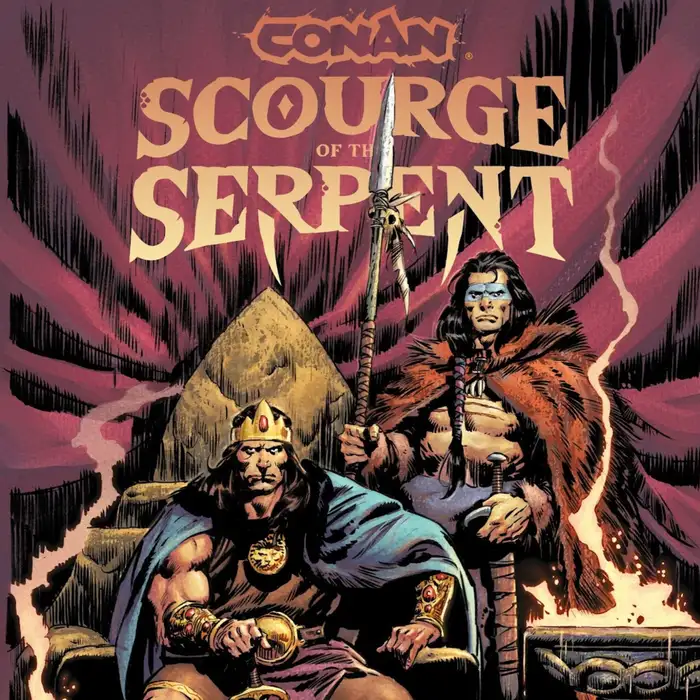
The stories suggest that while Conan is exceptional, he’s not unique – Cimmeria produces hard men as reliably as its clouds produce rain. However, it must be noted most of these meetings are from later authors and the Conan comics, not from REH himself.
“The Frost-Giant’s Daughter” touches on Cimmeria and the northern regions. Various stories reference Conan’s youth and the battles that first bloodied him. But the full picture of Cimmeria must be assembled from scattered references and implications rather than detailed depiction.
The Historical Cimmerians
Howard borrowed the name from actual history. The historical Cimmerians were a people who lived north of the Black Sea and clashed with various ancient kingdoms. They left few records and remain somewhat mysterious – which presumably appealed to Howard’s imagination.
The connection is more nominal than substantial. Howard’s Cimmerians are Celtic in culture, not steppe nomads like their historical namesakes. I think Howard simply liked the name and the obscurity, which gave him freedom to create his own vision without contradicting well-known history.
This approach characterises Howard’s worldbuilding generally. He borrowed names, images, and moods from history whilst freely reinventing everything else.
In my view, this method created something more compelling than either pure invention or faithful recreation – a world that feels historical without being bound by history.
Why Cimmeria Matters
For understanding Conan, Cimmeria is essential context. Every time Conan reacts with suspicion to sorcery, with contempt for weakness, or with practical brutality to threats, his Cimmerian upbringing explains it. He’s not arbitrarily tough – he was made that way by a land that permitted nothing else.
I would argue that Cimmeria also represents something in Howard’s own psychology. The desolate beauty, the melancholy, the fierce independence – these themes recur throughout his work and letters.
Cimmeria might be where Howard himself would have belonged, in some alternative life.
For modern readers and fans, Cimmeria offers a touchstone. When adaptations get Cimmeria right – the greyness, the harshness, the grim determination – they usually get Conan right too. When they make Cimmeria too bright or too comfortable, something essential is lost.
FAQs
Was Conan’s entire family from Cimmeria?
Yes, Conan was born to Cimmerian parents and raised entirely in Cimmeria before leaving as a youth. His famous line about being born on a battlefield during combat suggests the harsh circumstances typical of Cimmerian life.
What is Crom like as a god?
Crom is a grim deity who grants his worshippers nothing except the will to survive and succeed. Cimmerians don’t pray to him because he doesn’t answer prayers. He simply judges the dead, sending the worthy to a grey afterlife and the unworthy to oblivion. I would say he’s the perfect god for a harsh land.
Why did Conan leave Cimmeria?
Conan left seeking adventure and broader horizons. Even by Cimmerian standards, he was restless and curious about the wider world. His departure as a youth began the wandering life that would eventually lead him to a throne.
Is Cimmeria based on Scotland or Ireland?
Both, along with general Celtic influences. Howard drew on his reading of Celtic history and mythology without tying Cimmeria to any single real-world culture. The result is Celtic-flavoured but distinctly its own creation.
Does Conan ever return to Cimmeria?
In the original Howard stories, returns to Cimmeria are rare or non-existent. Later writers have explored this possibility, but Howard himself kept Conan moving forward through the Hyborian world rather than circling back to his origins. He does semi/regularly in the comics, though.